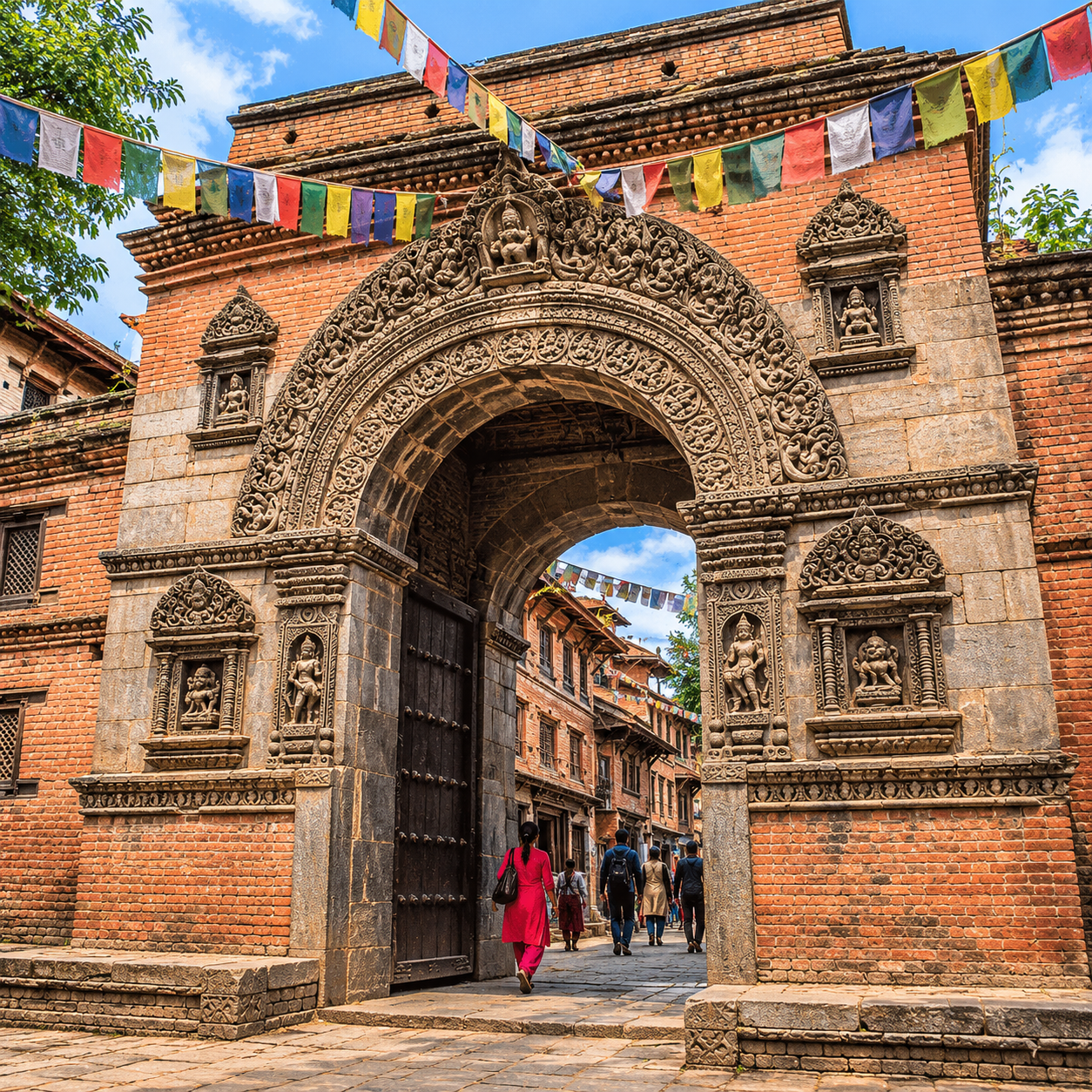
Sankhu, also called Sakwa, is an ancient Newar town in the north-eastern corner of the Kathmandu Valley, about 17 km from the city centre. Its oldest known inscription dates to 538 AD, in the Licchavi period. Its well-preserved lanes and temples hold around 1,500 years of continuous history, yet it sees far fewer visitors than the valley's famous heritage squares. One explanation of the name Sakwa is that it means "a town below Tibet". According to tradition, the first king built the town in the shape of a conch shell.
For centuries, Sankhu stood on the trade route from Kathmandu to Lhasa, and it was the last valley town before the mountain climb on the seven-day journey to Tibet. That position brought wealth, craftsmanship and religious significance. The traditional Newar settlement still keeps its medieval character, with narrow streets, public squares, tiered temples and rest houses. Walking through its brick lanes and courtyards today gives a quiet look at daily Newar life, away from the crowds.
On a forested hillside about 1.5 km north of the town, the Bajrayogini Temple is one of the most significant Tantric pilgrimage sites in the Kathmandu Valley. The goddess is one of the four Vajra Yoginis of the valley. The climb to the temple is by a long stone stairway through forest, and the complex is revered by both Buddhists and Hindus. The Bajrayogini Jatra, a major festival among the local Newar community, is held each April.
Sankhu is also known for its winter pilgrimage. Each year, the month-long Salinadi Mela draws devotees who walk barefoot along the Shalinadi riverbanks in the cold, for spiritual purification and the story of Swasthani. Pilgrims visit from the full moon of Poush to the full moon of Magh, and the festival of Madhav Narayan is also celebrated here.
With ancient trade history, a hilltop Tantric shrine, living festivals and an unspoiled Newar town centre, Sankhu suits culture lovers, hikers and photographers who want to see Kathmandu Valley heritage beyond the usual stops. It is also the natural starting point for the Sankhu to Nagarkot hike.